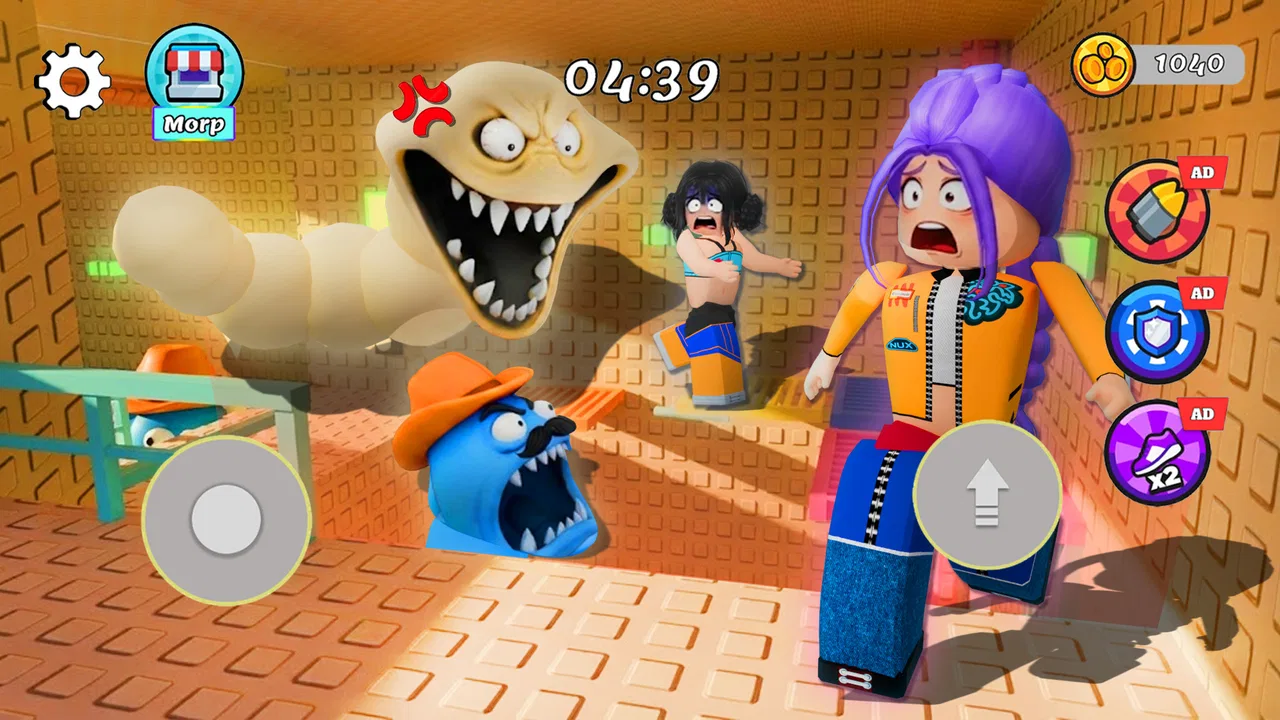
Brainjot Prison: Escape Obby
- 4.0
- Rating
- 1.00M
- Installs
- Free
- Price

 Analysis by App-foxy
I spent time with Brainjot Prison: Escape Obby as a quick-reaction adventure game, and my first impression was clear: it wants you moving before you have much time to think. The whole appeal is built around dashing through dangerous obstacle sections, reading what is ahead, and trying again when a trap catches you. That makes it easy to understand within moments, but not necessarily easy to master.
Developed by CptGaming, this free game is aimed at players who enjoy short bursts of action rather than a slow, story-heavy adventure. Its Teen content rating also gives you a useful idea of its tone: the setting and danger are more intense than a gentle family platformer, even though the basic objective is straightforward. I found it most enjoyable when I treated each attempt as a small challenge instead of expecting a long narrative journey.
How the prison escape feels in everyday play
The central rhythm is simple. You enter a threatening environment, move through hazards, make quick decisions, and recover from mistakes by trying again. That simplicity is a strength because there is very little setup between opening the game and getting involved. If I had only a few spare minutes, the concept made sense immediately.
You May Also Like

 Blood Strike: 2.5 Anniversary
Blood Strike’s Loadouts Turn Every Drop Into a Tactical Gamble
A close look at Blood Strike’s custom loadouts: how fast access to signature weapons reshapes its battle royale rhythm, rewards preparation, and narrows the gap between fights.

 Pandora - Music & Podcasts
Pandora’s Music Is Easy to Start, but Harder to Recover
Pandora’s strength is its low-effort path from a seed to a station. Its weak spot is how much confidence it asks you to place in connection, setup, and quiet recovery.

 8 Ball Pool
 Is Built on Rivalries, Rematches, and Routine
A close look at the rivalries, rematches, shared routines, and unanswered safety questions that turn a quick pool match into a persistent mobile community.

 Samsung Music
’s Quiet Strength Is Playing What You Already Own
Its reach comes less from spectacle than from dependable access to a personal library. That simplicity is both the app’s strongest retention engine and its ceiling.

 AccuWeather: Weather Radar
AccuWeather Review: A Quick, Clear Forecast for Everyday Decisions
For everyday plans, the best forecast is the one you can understand quickly. AccuWeather makes rain timing, radar, and local conditions easy to act on, with a few trade-offs.

 Hill Climb Racing
Why Hill Climb Racing Still Turns Crashes Into One More Run
A tiny car, a bumpy hill and one more upgrade: Hill Climb Racing keeps resurfacing because its simple chaos makes every near-miss feel personal.
More From Our News Desk



At the same time, a simple premise places more pressure on the obstacle design and controls. There is not much room for a complicated inventory, a deep character build, or a large collection of side activities to distract from the route itself. The game has to make movement and timing feel satisfying, because those are the reasons to keep playing.
I would describe the experience as an adventure obby built around repeated attempts. That distinction matters. Someone looking for exploration with extensive dialogue may find the format narrow, while a player who likes testing reflexes can appreciate the directness. The prison theme gives the runs a recognizable identity, but the real test is how confidently you can handle each dangerous section.
What to expect from the pace
The store summary promises a dash through deadly traps and frightening worlds, and that points to a fast-feeling style rather than a relaxed platforming tour. In practice, I approached every new section by first watching the rhythm of the hazards, then committing to movement. That small pause before acting is useful: speed is important, but rushing blindly usually turns a manageable obstacle into another restart.
The perceived speed also depends on how familiar you become with a route. Early attempts feel hectic because you are processing the environment and deciding where to move next. After a few tries, the same passage can feel much quicker, not because the game changed, but because your decisions become more automatic. This is one of the better reasons to replay a section instead of abandoning it after one failure.
For a realistic everyday scenario, imagine opening it during a short break while waiting for a bus or taking a pause between tasks. You can begin without learning a large system, make a few attempts, and stop when your attention is needed elsewhere. I would not choose it for a calm evening when I want something meditative, but it fits a quick session where a little tension is welcome.
Where heavy use becomes noticeable
The demanding moments are not necessarily long sessions; they are the moments when several decisions arrive close together. A player may need to judge a gap, react to a trap, and maintain a route through a threatening area without losing momentum. Those sequences concentrate the game’s pressure into a small amount of time.
Repeated failures can also make the experience feel heavier from a mental point of view. The game’s design encourages learning through retries, but that only works if the restart cycle feels fair and understandable. When I miss an obstacle because I mistimed a move, I am willing to try again. When a failure feels unclear, the same loop becomes frustrating rather than motivating.
My practical advice is to separate learning attempts from speed attempts. On the first pass through an unfamiliar area, focus on identifying the safe timing and the shape of the route. Once you understand that sequence, try to improve your movement. This approach reduces unnecessary frantic inputs and helps reveal whether a problem is your timing or the game’s presentation.
Another useful habit is to avoid playing while distracted. Because the challenge is based on immediate reactions, a notification, conversation, or momentary lapse can ruin an attempt more easily than it would in a turn-based adventure. The game is a better fit for short periods when you can give the screen your full attention, even if the session itself is brief.
Recovery after a failed attempt
Recovery is central to this kind of game. A failed run should teach you something: which trap you misread, where your timing slipped, or which part of the route deserves more caution. I found the experience more rewarding when I treated each mistake as information rather than as a wasted attempt.
That mindset also helps with the game’s emotional curve. The frightening setting may make a failure feel dramatic, but the underlying challenge is still about control and repetition. If you prefer games where progress is mostly permanent and mistakes rarely send you back, this may not be the right choice. A more forgiving adventure or a story-led platformer would suit you better.
For players who enjoy retries, the recovery loop is the main attraction. You can refine one section at a time instead of needing to understand the entire game immediately. I recommend changing only one part of your approach after a failure. If you alter movement, timing, and route choice all at once, it becomes difficult to know what actually solved the problem.
Reliability and the feel of a stable session
My overall impression is that the game’s reliability matters most during quick, concentrated attempts. A fast obstacle game needs the controls and visual response to feel consistent enough that the player can trust their timing. When that relationship works, success feels earned. When it does not, even a well-designed trap can feel like an argument with the device.
I would not judge stability only by the fact that the game is easy to start. The more meaningful test is whether it remains comfortable through repeated attempts, especially when you replay the same dangerous sequence several times. That is where small interruptions, unclear reactions, or performance dips would become most irritating, because they interfere directly with learning.
Since the game is currently at version 1.6, I would keep it updated through the normal store process rather than relying on an old installation. Updates can be especially relevant for a game whose appeal depends on responsive movement, although I would not assume that a version number alone guarantees better performance on every phone.
The game has attracted over a million installs and holds an average rating of four out of five from around one thousand three hundred ratings. Those figures suggest that it has reached a substantial audience and that the basic idea works for many players, but they should not replace your own priorities. A popular obstacle game can still be a poor match if you dislike retries, tense timing, or the prison-horror atmosphere.
Device constraints and practical expectations
The minimum operating-system requirement is Android nine, so compatibility is not limited to only the newest Android phones. That is helpful for people using an older device, but operating-system support is only one part of the experience. Screen responsiveness, available storage, background activity, and the general condition of the phone can all affect how comfortable a fast game feels.
I would close other demanding apps before playing on an older or busy phone, especially if you notice delayed input or an uneven response in other games. This is not a promise that every performance issue will disappear; it is simply the most sensible first step when a reaction-based game feels less responsive than expected.
Players on modest hardware should also pay attention to heat and battery behavior during longer sessions. I would not assume that a free game is automatically light on resources. The safest approach is to begin with a short session, check how the phone feels, and avoid continuing if the device becomes uncomfortably warm or the battery drops faster than you accept.
On a newer phone, the main benefit may be consistency rather than a completely different game. Faster hardware cannot replace good timing, but it can reduce the chance that the device becomes the source of uncertainty. For this reason, I see the game as more suitable for a reasonably responsive Android phone than for a device already struggling with basic multitasking.
How it compares with other adventure choices
Compared with a traditional adventure game, this one puts far less emphasis on wandering, dialogue, puzzles based on clues, or building a long-term character. Its advantage is immediacy: you know what you are trying to do, and the next meaningful decision is usually related to movement through danger.
Compared with a slower platformer, the prison escape format feels more urgent and less forgiving. A slower alternative is better if you want time to study a level, enjoy scenery, or make careful progress without constant pressure. Brainjot Prison is the stronger choice when the fun comes from reacting quickly, learning a route, and improving through repetition.
It also differs from endless runners because the challenge feels more tied to navigating designed obstacle situations than simply surviving for as long as possible. If you prefer a score-chasing loop with minimal stopping, another runner may feel more natural. If you want each failed attempt to help you understand a particular hazard, this game has a clearer learning appeal.
Who will enjoy it, and who should skip it
I would recommend it to players who like short, tense sessions and do not mind repeating a difficult passage. It is particularly suitable for someone who enjoys turning a first messy attempt into a cleaner second or third run. The free price also makes it easy to try without making a purchase decision first.
I would be more cautious about recommending it to players who need a substantial story, relaxed exploration, or a broad collection of activities. The same focused design that makes it accessible can feel limited if you want a large adventure with many different forms of progress. It is also not my first choice for young children, given the Teen rating and the threatening tone suggested by its setting.
People who are sensitive to repeated failure should try it in small doses. A ten-minute session can be satisfying, while pushing through frustration for a long time may make the game feel harsher than it needs to be. Stopping after a difficult sequence and returning later is not giving up; for timing-based challenges, a fresh attempt often produces better results.
My final assessment of speed, stability, and value
Brainjot Prison: Escape Obby works best when you want a direct adventure challenge rather than a large, leisurely game. Its strongest quality is focus: traps, movement, danger, and the satisfaction of surviving a section are all closely connected. I also like that the premise is understandable immediately, which makes it practical for short breaks and casual testing.
The trade-off is equally clear. A game centered on obstacle runs and retries can become repetitive for anyone who needs constant novelty or a strong narrative reason to continue. Its performance experience will also depend on the Android device, so I would judge it after a short trial rather than assuming that broad compatibility means identical smoothness everywhere.
My verdict is positive but specific: try it if you enjoy fast reactions, route learning, and the small victory of finally clearing a trap that stopped you before. Skip it if you want a calm adventure, deep character progression, or forgiving exploration. For the right player, the real value is in improving one escape attempt at a time, not in treating it as a conventional story game.
FAQs for Brainjot Prison: Escape Obby
01What is Brainjot Prison: Escape Obby?
Brainjot Prison: Escape Obby is a prison-themed obstacle and escape game in which you guide your character through challenging stages, traps, jumps, and puzzles. The main objective is to find a route out of the prison while avoiding hazards and completing platforming sections. It combines simple controls with progressively more demanding levels designed for short, casual gaming sessions.
02How do you play Brainjot Prison: Escape Obby?
Gameplay is based on moving your character through prison environments, jumping across platforms, avoiding obstacles, and reaching the exit of each stage. Depending on the level, you may need to time your movements carefully, choose the safest path, and retry sections after making a mistake. The controls are generally easy to understand, but later obstacles require patience and accurate timing.
03Is Brainjot Prison: Escape Obby suitable for children?
The game is generally appropriate for players who enjoy cartoon-style obstacle courses and light escape challenges. Its prison setting may sound serious, but the experience is presented in a playful, non-realistic way rather than as a violent simulation. Parents should still review the app’s age rating, advertisements, and any available purchase options before allowing younger children to play.
04Does Brainjot Prison: Escape Obby require an internet connection?
The core obstacle-course gameplay may be playable without a constant internet connection, which can make it convenient for quick sessions while traveling or when Wi-Fi is unavailable. However, some features, advertisements, analytics, updates, or promotional content may require connectivity. Because requirements can change between versions, it is best to test the installed game offline and check its store listing.
05Is Brainjot Prison: Escape Obby free to download and play?
Brainjot Prison: Escape Obby is typically offered as a free download, allowing players to try its main gameplay without paying upfront. Free mobile games may include advertisements, optional purchases, or other monetization features, so you should check the official Google Play or App Store listing before downloading. Also review requested permissions and disable in-app purchases if children use the device.
Pros
- Simple controls make it easy to start playing quickly.
- Short escape sections are suitable for quick gaming sessions.
- Bright visuals make obstacles and paths easy to recognize.
- Progressive challenges provide a satisfying sense of improvement.
- Works well for players who enjoy timing and platforming challenges.
Cons
- Some obstacle patterns may feel repetitive after extended play.
- Precision jumps can be frustrating on smaller phone screens.
- The game may offer limited depth beyond completing escape stages.
- Mistakes can require repeating sections
- which may slow progression.
- Performance and loading times may vary across older devices.

Brainjot Prison: Escape Obby
Gallery